You found a “best rate”—then the fine print
The “best rate” looks clean on a leaderboard until you click through and realize it’s a narrow slice of borrowers and a narrow slice of loan setups. You’re sitting on meaningful equity and the project budget is real, so the ad rate feels like a benchmark. Then the quote comes back higher, and it’s not obvious whether you’re being overcharged or simply being priced into a different box.
The fine print usually lives in three places that change the math: credit and combined loan-to-value cutoffs, how the lender treats small vs large line sizes, and whether the product is temporarily discounted. A HELOC teaser tied to prime can be low today but paired with an early-closure fee, an annual fee, or a draw requirement. A home equity loan “as low as” rate can assume a short term, automatic payments, and points you didn’t plan to pay.
Rate leaderboards vs your quote: why it diverges

By the time you’ve entered an address and a rough loan amount, the leaderboard rate has already stopped being the right reference point. Most tables are showing an ideal borrower at an ideal risk band: high credit, low combined loan-to-value, owner-occupied, single-family, and a loan size that fits the lender’s sweet spot. If your first mortgage balance is larger than the “example” scenario, or you’re pushing into an 80%–90% CLTV tier, the same lender can reprice the offer quickly—sometimes by more than the difference between lenders on the leaderboard.
Then the quote starts reflecting rules the leaderboard never mentions. Some lenders price HELOCs by line size and expected utilization, so a $30,000 line can look worse than a $100,000 line even with identical credit. Others bake in relationship discounts, autopay reductions, or a temporary intro margin that disappears after six to twelve months. And if your debt-to-income is tight because you’re consolidating balances, the payment assumption they use (interest-only draw vs fully amortizing) can bump the rate tier before you ever see an APR.
HELOC or home equity loan: two rate worlds
Once you stop treating “home equity” as one product, the pricing starts to make more sense. A HELOC quote is usually prime plus a margin, and the lender is mostly underwriting an open line that can be drawn, repaid, and drawn again. That flexibility shows up in the rules: draw periods, minimum draws, annual fees, and sometimes an early-closure fee if you pay it off within the first 24–36 months. If your renovation spending is lumpy, that structure can fit—until you realize your payment during the draw may be interest-only and the real payment jump is deferred.
A home equity loan is priced more like a second mortgage: fixed amount, fixed term, fully amortizing from day one. The rate can look higher than the best HELOC teaser, but the APR often narrows once you account for fees and the fact that you’re locking a payment schedule now. If your goal is debt consolidation and you need predictable cash flow, the “worse” rate can be the safer math.
APR isn’t one number: unpack fees and traps
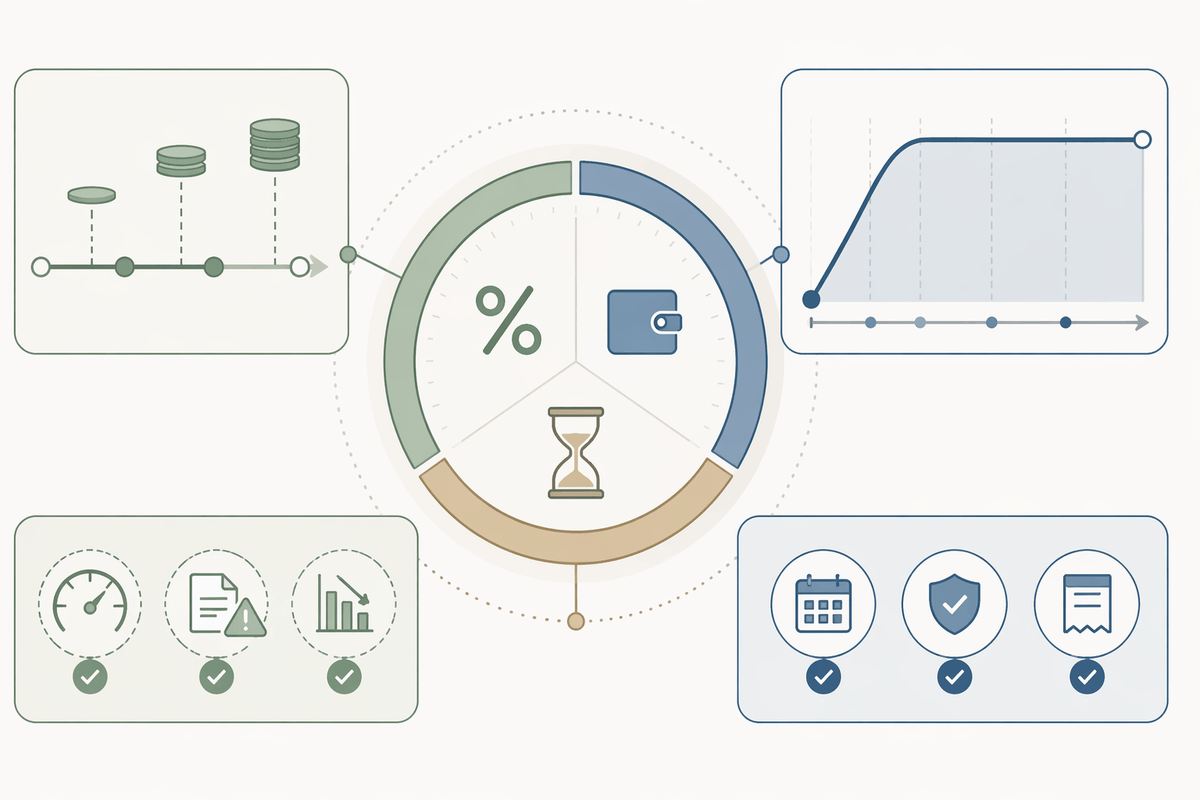
The first APR you see is rarely the APR you live with, because it’s built on assumptions that don’t match how most projects actually get funded. Some lenders quote APR as if you draw the full HELOC immediately and keep it outstanding, which makes a low-fee line look better than a line with an annual fee that only bites if you leave it open. Others assume a small, steady balance that understates cost if you’re really about to pull $80,000 in the first two months and carry it for a year.
That’s why “no closing costs” needs a second look. Sometimes it’s truly lender-paid; sometimes it’s rolled into a higher margin or an origination charge hidden as “processing” or “underwriting.” Early-closure fees are the quiet trap when you’re using equity as a bridge: pay it off after the contractor is done, and you can trigger a charge within the first 24–36 months. On fixed home equity loans, points can buy down the rate, but if you refinance or sell sooner than planned, that APR math stops being your friend.
When offers feel close, I’ve had better luck treating APR as a checklist, not a verdict: which fees are conditional, which are guaranteed, and which show up only if your timeline goes faster than the lender’s break-even model.
Fixed vs variable exposure: what happens when rates move
At this point the rate question stops being “who’s cheapest” and becomes “what am I exposed to.” A variable-rate HELOC can look like the obvious winner when prime is steady, but the payment is a moving target. If you’re carrying a $120,000 balance during a draw period, even a modest move in prime can change the monthly cost immediately, and the lender’s lifetime cap only helps after you’ve already absorbed several hikes. The friction is timing: renovations and life don’t wait for a friendly rate cycle.
A fixed home equity loan flips the risk. You pay a known premium (sometimes small, sometimes not) to freeze the payment schedule, which matters if you’re consolidating debt and your budget is already tight. The surprise usually comes later: variable HELOCs often start interest-only, then reset into amortizing payments when the draw ends. Fixed loans don’t “jump,” but they also don’t let you float down unless you refinance, and that’s another round of costs and underwriting.
When I compare offers, I stress-test two numbers: the HELOC payment at a +2% and +4% rate move, and the fixed-loan break-even if rates fall and you’d be tempted to refinance within three years.
How to shop lenders without burning your credit
After the stress-test, the next friction is the shopping process itself. You want three or four quotes, not one, but you don’t want to watch your score wobble because every lender pulls a separate hard inquiry on a different day. The cleanest pattern I’ve seen is to start with “soft” signals: lenders that will show a prequalification or a preliminary range off a soft pull, your stated CLTV, and an estimated draw amount. That gets you past the teaser rates and into realistic pricing without committing your credit file yet.
Once two offers look genuinely comparable, that’s when the hard pull is worth it—and it’s worth clustering. Do the full applications close together, use the same loan amount and structure in each, and ask each lender exactly what they need to lock: some will lock the margin on a HELOC but not waive fees until later, others will lock only after appraisal. While you’re at it, confirm whether the appraisal is automated or full, and whether there’s a fee if the value comes in short.
If a lender won’t give a written fee sheet and lock terms before running credit, I treat that as a signal to move on.
Pick the offer that survives worst-case math
Once you have two or three written offers, I stop asking which one is “cheapest” and start asking which one still works if the timeline and rates go against you. Run the payment at the maximum balance you expect to carry, not the line size. For a HELOC, price it at today’s index plus margin, then again at +2% and +4%, and add any annual fee. For a fixed loan, add points, origination, and the real monthly payment from day one.
Then layer in the non-rate failure points: the draw minimum you might trip over, the early-closure fee if you repay fast, and what happens when the draw ends and amortization starts. The offer that survives the ugly version of your plan—higher rates, slower project, longer payoff—is usually the one that’s actually affordable.