You hear 'bank run' rumors—what matters first
The first time a “bank run” rumor hits your feed, it rarely lands as a clean headline. It shows up as a delayed wire, a friend saying they moved money “just in case,” a notice that a transfer window closes early. The friction is the signal: once people expect other people to bolt, the math changes fast, even if the institution was fine yesterday. In 1907, that shift in expectation moved quicker than formal information, and it punished anyone who waited for certainty that never arrived.
What mattered first wasn’t the rumor’s drama, but the structure underneath it: who could demand cash today, and what assets could actually be turned into cash without fire-sale losses. If the most “immediately payable” promises were backed by loans or securities that needed time to sell, the gap invited a run.
So the initial triage was practical: Is there a credible backstop, or is liquidity limited to what’s on hand? In 1907, the absence of a standing public lender meant the crowd’s timing became the constraint—and timing, not insolvency headlines, set off the cascade.
Easy money felt safe until trust companies rewrote rules
That missing backstop pushed cash toward whoever looked cleverest at “liquidity management,” and in the mid-1900s that often meant trust companies. They marketed themselves as a modern alternative to national banks: fewer constraints, higher yields on deposits, and a balance sheet that could lean harder into securities and call loans. It felt like easy money because the cycle rewarded it—equity prices were strong, collateral looked dependable, and short-term funding rolled over with little negotiation.
The rule rewrite was quiet but decisive. Trust companies held thinner cash reserves than national banks, and many sat outside the clearinghouse system that could coordinate support in a scare. So the same promise—“payable on demand”—was backed by assets that were liquid only as long as markets stayed orderly. The constraint wasn’t theoretical; it was timing. If large depositors asked for cash on Tuesday, the trust’s collateral might only sell on Wednesday, and only at a discount.
In that setup, a small shift in confidence stopped being noise. It turned into a funding test the trusts were structurally less equipped to pass, even before anyone could argue about long-run solvency.
A failed corner turned private losses into public panic
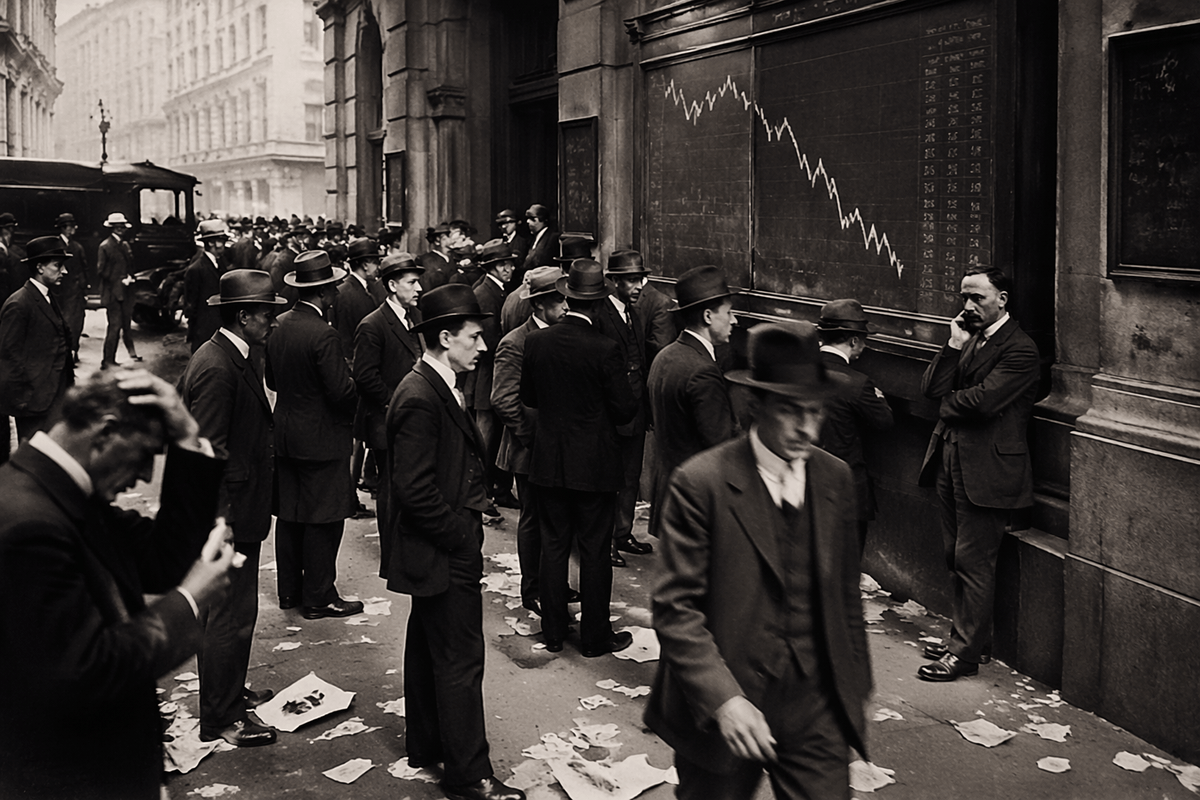
The spark wasn’t a slow credit deterioration; it was a trading scheme that failed in public. Speculators tied to the Heinze–Morse circle tried to corner United Copper, leaning on borrowed money and the assumption that short sellers could be forced to buy at any price. When the stock broke instead of squeezed, the losses didn’t stay on the brokerage blotter. Margin calls hit immediately, collateral values fell, and lenders began asking a different question: which institutions were funding this group, and could they be forced to liquidate into a falling market?
That’s when private leverage turned into public suspicion. Trust companies weren’t judged on a quarterly balance sheet; they were judged on whether cash would be there at 10 a.m. If a trust was linked—directly or through directors and deposits—to the failed corner, depositors treated it as a liquidity problem even if asset values might recover later. Once clearinghouse support looked uncertain for the trusts, the cost of waiting became higher than the cost of withdrawing, and the panic became rational behavior.
Withdrawals start where promises look most breakable
After the United Copper failure, the first real withdrawals didn’t scatter evenly across “the financial system.” They concentrated where the promise was most brittle: payable-on-demand liabilities funded by assets that were only “money-good” in calm markets. Trust companies fit that profile. Many had large, confidence-sensitive depositors—corporate treasurers, brokers, and wealthy clients—who could pull six or seven figures in a morning, not a week. The constraint wasn’t long-run credit quality; it was the intraday cash drawer. If a trust had to sell securities into a falling tape to meet Tuesday’s lines, it was taking a visible loss just to stay open until Wednesday.
That’s why contagion traveled through governance and mechanics, not just headlines. A director’s name linked to the Heinze–Morse circle, a hesitation about clearinghouse help, a rumor that call loans couldn’t be collected fast enough—each made the “on demand” promise feel conditional. Once depositors suspected they’d be paid last, the cheapest move was to be early, and early became the whole game.
When cash disappears, payment plumbing becomes the crisis

Once depositors learned the lesson—be early—the next constraint wasn’t just whether a trust could survive a week. It was whether the city could settle today. Cash started getting pulled out of circulation and parked in vaults, which meant perfectly “sound” counterparties suddenly couldn’t complete routine payments. Brokers needed currency to meet margin calls and settle trades; merchants needed it to pay suppliers; factories needed it for Saturday payroll. When everyone asks for the same scarce instrument at once, the system stops being about credit judgment and turns into a queuing problem.
That’s when the plumbing shows. New York’s clearinghouse banks could coordinate among themselves, but trusts sat awkwardly outside that machinery. Banks, protecting their own reserves, tightened on call loans and became slower to extend daylight liquidity. As settlement frictions piled up, institutions improvised: substituting clearinghouse certificates and accepting “cash-like” instruments, while restricting cash withdrawals. Those steps kept some doors open, but they also advertised that par, on-demand money had quietly become conditional—and that’s the moment a funding scare becomes an economy-wide payment crisis.
J.P. Morgan’s rescue worked—then revealed a dangerous gap
By the time withdrawals were turning into a settlement gridlock, the market wasn’t waiting for a committee—it was watching for a name that could coordinate action quickly. J.P. Morgan stepped into that role, pulling bankers into a single room, forcing triage, and pushing cash toward the institutions whose failure would have snapped the payment chain first. The constraint was brutally short-term: hours, not days. Support had to arrive before the next morning’s lines formed, and it had to be big enough to change expectations, not merely cover a few checks.
The rescue largely worked because it created a temporary lender-of-last-resort through private bargaining: pooling reserves, leaning on the clearinghouse, and extracting concessions from weaker players so stronger ones would fund them. But the aftertaste was the real lesson for modern cash managers. The “backstop” depended on one organizer’s credibility, on voluntary participation, and on imperfect information gathered mid-panic. That meant the system’s safety net was optional, uneven, and late—exactly the kind of gap that turns liquidity stress into policy reform.
Reforms after 1907 built today’s lender-of-last-resort playbook
After the rooms cleared and the lines thinned, the uncomfortable constraint was obvious: New York had survived because a private syndicate chose to act, not because a public mechanism was designed to. That is a fragile way to run payrolls, settle trades, and keep solvent firms from failing on timing. The reform impulse wasn’t abstract “stability”; it was a practical demand for a standing source of emergency liquidity that could lend against good collateral when everyone else refused.
The response ran through the National Monetary Commission and, eventually, the Federal Reserve’s creation in 1913—an institutional lender of last resort with discount window tools and a payments backbone. For investors and cash managers, the playbook shift is the point: crises still begin with confidence and collateral, but outcomes change when the backstop is pre-committed, rules-based, and operational before the next Tuesday morning queue forms.

![9 Best Schwab ETFs to Buy [Build Your Core for Cheap]](static/image/2026/07/14/a69dc979-3836-472e-a76d-f75927794650.png)